Awa, my homolouges daughter, is around 20 years old, I think. She claims she’s 22, but everyone else says she’s either 16, 18, 20, 17- no one seems to know for sure- which is not uncommon for Malian women. After spending many months with her, I think she might have a slight learning disability. She’s nice enough, and does the cooking and cleaning for Irene’s household. She can be bothersome at times, talking to me like I’m a baby in really simple Bambara, but really she’s alright. However this past week, she has not been herself. Even since Irene yelled at her for hitting Denise, her little sister, she has basically shut down. She claims she is sick, and boy she looks it. She refuses to eat, refuses to work. Therefore, Irene has been cooking my lunches and with her work, sometimes I wait one, two, three hours for food. I try to help, yes, but they only entrust me with very simple tasks. Mashing onions. Then I’m done. Awa stays in her room, laying in bed, all day, except to go to the negen. And when Irene would usually shove her baby to Awa, she now gives him to me to watch. I’m concerned about Awa, and encourage her to see the doctor, which she does, but will not ask her mother for money to pay for medicine, so basically it is worthless.
So I spent another long afternoon sitting around Irene’s house thinking about what I haven’t done this week. Well we found a few more of the lost malnourished babies. I did some boring computer work for my supervisior, but was also able to teach him and some teenage boys how to enter the medical records in our “new” (ie 1998 PC). Alright. Donni, donni. I took out a piece of paper and began writing a letter to home, speaking of the “small accomplishments” that despite all the obstacles keep me going. Just then, a motorcycle pulled up. It was my homolouge’s brother, an English teacher who she had been anxious for me to meet. Really though, his English was no better than my Bambara, but we enjoyed some good conversation in over lunch. Irene stops eating and asks him to “Explain in to her in English.”
The man turns to me. “Awa is very bad. She doesn’t work.”
“I think she is sick.”
“No. She is not sick. She is hungry. She doesn’t eat. She doesn’t work. She is very bad. Her mother is mad.”
“I understand.” I do. She is probably sick, but she has had a bit of an attitude. Refusing to eat or do her usual work is not really admirable but let’s put things in perspective here. She’s somewhere between 16 and 22, she hardly has a 4th or 5th grade education, she is stuck at home all day watching over two small children and cooking. Her big plan, she once told me, is to start making biscuts and selling them at the health center. Then, she will save up enough money to buy a bicycle in which she can ride to go to school in Dio, about 5 miles away. So far, I haven’t seen any biscuts. But she usually takes pride in her cooking- my lunches, though rice and sauce everyday, are tasty enough. She usually as a smile on her face. Until lately.
“I have come to correct this,” the uncle says.
“I understand.” Oh, I thought naively, this is just like they taught us in cultural class. When two people are not getting along, a third party comes in to settle the disagreement. The uncle had ridden his motorcycle from Kati, and before lunch, he had a good stern talking with Awa in the presence of her mother.
Wait a minute.
“So it’s good now? It is corrected?” I asked.
“No! It is not good!”
“What are you going to do?”
“I am going to beat her!”
I look at Irene, who does not understand the English, but understands that he has just explained it to me. After lunch, we talked some more. I was thankful that though his English was sub-par, we could have a private conversation. I spoke carefully, telling him that this was not what we do in America and that I didn’t agree with it. Yet he insisted that this was the only way to get her to behave. I didn’t want to offend the Malian way, but I do not want to see my friend hurt and I do not think this will change her attitude. Now he’s in a predicament.
“I respect you,” he says, “and I want you to respect me. But I must do this. But then you will not respect me.”
“And I,” I said, “if I am the reason that your action is prevented, and Awa does not begin working again, Irene will loose respect for me.”
“This is true.”
So I talked to Awa, she barely listened through trembling tears while the rest of the CSCOM staff laughed at me for paying attention to her. Receiving no response from the girl that had already surrendered to her punishment, I asked her uncle, “If you would like me to leave, I understand.”
“No. I am going to leave,” he said.
And with that he gave Awa another stern talking to, and then pulled me aside. He expressed his respect for me, and his understanding of why I did not agree with his actions. He then invited me to his classroom to give a lesson one day in the future. We shook hands, he mounted his motorcycle, and was off. He’s really a good guy, I thought. Irene gave me a tender smile, and nodded her head in approval. I went back to my letter; it’s the little accomplishments.
My only concern after that was that Awa was not going to shape her act up, and that I was going to be the one to blame. But nevertheless, Awa was back to her old self the next day, which happened to be the feast of Tabaski. Her, I and Sali, the nurse’s assistant, a fun loving, pretty girl my age who has become a great friend, all went to the “donke yorro” (dance place) - which was a high school classroom transformed into a sort of dance club. Though I felt like the dorky exchange student, dancing by myself in the corner, I was happy to see Awa shakin her booty around the boys, with her goofy, drooling laugh. Things were going to be back to normal. And though I do not totally understand her emotional trouble, or am not totally convinced of their resolution, at least she returned to her character without having to be physically beat into it.
Tuesday, December 23, 2008


Saturday, December 13, 2008
A few pictures from Tabaski


As unreliable transport got me to a computer about 4 hours later than I expected, and the sun is about to set in Bamako, my journal entries on the Muslim feast of Tabaski have yet to be entered on the computer. I do however have a few pictures to share of the event. Next Friday or Saturday check back for stories on goat slaughterings, me playing the traditional zylophone, and other such adventures. Until then, here are some pics. The one of the boys is my posse, the tallest one being Shaka. My sisters pounding millet, and the morning prayer.


Friday, November 28, 2008
Inside the hut
Upon Dad's request...
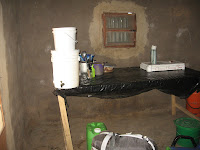

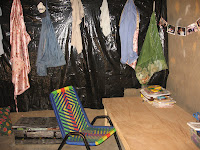
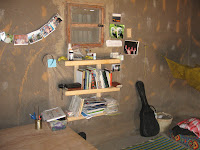

From bottom to top:
1. This is where I sleep, though I put the mosquito net down at night. And whoops, I left my underwear out hanging to dry. My host mom washes my clothes but its not really right to give someone your own underwear to wash, so I do that myself and it dries out of the view of the public eye.
2. My bookshelf and pictures of all you guys.
3. My desk and my "closet" (a large piece of plastic and some nails. I also have a small trunk where I keep shirts and stuff
4. Here is my kitchen/ storage area.
5. My kitchen counter table. It is covered in plastic. The big white thing is my water filter, and the small white box is my stove. I carry water in from the well in the large green bucket and dump it in periodically when I need water, then I treat it with bleach. The purple bucket is fresh peanut butter I buy at the market.
Now the home didn't come furnished mind you. All tables and shelves were handmade by carpenters in Kati, transported the 18 miles to Dombila by brush bus and donkey cart, compliments of my awesome host dad, Daramane
I spared you pictures of the "negen". Think hole-in-the-ground and there you go.
Not the fanciest of homes, but I like it. I actually don't spend too much time inside, but rather take out my chair or mat and sit under my hanger.


From bottom to top:
1. This is where I sleep, though I put the mosquito net down at night. And whoops, I left my underwear out hanging to dry. My host mom washes my clothes but its not really right to give someone your own underwear to wash, so I do that myself and it dries out of the view of the public eye.
2. My bookshelf and pictures of all you guys.
3. My desk and my "closet" (a large piece of plastic and some nails. I also have a small trunk where I keep shirts and stuff
4. Here is my kitchen/ storage area.
5. My kitchen counter table. It is covered in plastic. The big white thing is my water filter, and the small white box is my stove. I carry water in from the well in the large green bucket and dump it in periodically when I need water, then I treat it with bleach. The purple bucket is fresh peanut butter I buy at the market.
Now the home didn't come furnished mind you. All tables and shelves were handmade by carpenters in Kati, transported the 18 miles to Dombila by brush bus and donkey cart, compliments of my awesome host dad, Daramane
I spared you pictures of the "negen". Think hole-in-the-ground and there you go.
Not the fanciest of homes, but I like it. I actually don't spend too much time inside, but rather take out my chair or mat and sit under my hanger.
Thanksgiving Pictures
1. Dinner at the Ambassador's house!
2. Me and Chirs with his festive thanksgiving shirt fashioned by a Malian tailor
3. The regional group laughing over some pictures
4. My teammates Caroline, Dave, and Hunter


2. Me and Chirs with his festive thanksgiving shirt fashioned by a Malian tailor
3. The regional group laughing over some pictures
4. My teammates Caroline, Dave, and Hunter


Thursday, November 27, 2008
So Thankful
So Thanksgiving has arrived, and it still feels like mid-summer here. Until I really stop to think about it, things like apple cider, pumpkin pie, and colorful foliage (I guess even snow now I hear?) easily slip my mind. But as I sit here in my teammate Caroline’s hut, I am hit with the nostalgia of all these things. Simple things really, that I am missing now. But nonetheless, there is no lack of things, simple and great, that I can be thankful for today.
I am thankful I have found a place in my community. I am thankful that I have really gotten to know the Malians on a personal level.
I am thankful that my homolouge makes rice everyday for lunch instead of To, like most of her neighbors.
I am thankful I have stayed healthy- physically and emotionally- in a new and strange environment.
I am thankful for the fields to run in, the multitude of stars at night, the packages and letters from home. I just got a whole slew of letters today, and it embarasses me that I haven't been able to write everyone back in a timely manner.
I am thankful I can talk to my family once a week.
I am thankful that people back in the states are doing such honest and dedicated work to make the world a better place. Especially FACE AIDS Geneseo. If you haven’t checked out their amazing work this semester, you can see it here . Dec 1 is World AIDS Day, and there are tons of events going on, including the premier of “The One Who Speaks” a play that I adopted from and interview of an amazing Ugandan girl.
I am thankful that I grew up with the world of opportunities at my feet. My country, my community, and especially, my family, not only taught me but showed me that I could do anything I wanted to do, that I could be anything I wanted to be. And I see out here in the villages, there are people of such wisdom, talent, and potential, that were never offered piano lessons, were never taught how to use a computer, or even how to read and write, never had sports or theater or all of these other amazing things I had. I am thankful I went to a good school, I am thankful I have seen and learned about the outside world. I don’t know how I got so blessed.
I am thankful that people are actually starting to understand my Bambara.
I am thankful that the Troure twins, once severely malnourished, returned to the CSCOM healthy and plump. They are the first to officially graduate from our program.
I am thankful for the friends I have made here. My teammates Hunter, Caroline, Dave and Chris, have become like a family to me.
Going off of that, I am thankful I am safe. A scary experience, which I will spare you the details, occurred last week involving me loosing my way on a moonless night. With the help of friends, friendly strangers, and angles, I was guided to a safe harbor.
I am thankful for the support back at home, the eagerness to help, and the prospect of doing good work in Dombila off of your contributions.
Granola bars, new socks, calcium chews, whole grain cereals, protein powder, Gatorade or propel water powder, baby wipes, disposable razors, face wash, and pictures from home. I will be thankful for these things immensely, that is if anyone decides to send a couple in a Christmas package hint hint. The Malians also really liked almonds and Welch’s fruit snacks. And as I said before that big packages were hard to transport… well I can make it work…
Alright, enough for being greedy. This is a day to be thankful. And though my plans changed, it looks like I will still have quite an amazing Thanksgiving here in Bamako. If all works out, I will be attending Thanksgiving dinner at the ambassador’s house. Though it will be no clover lanes, no sunset bulavard, no aunt sue’s bread and jokes at the kids table, it may be nice. I can’t even begin to say how much I am going to miss home on thanksgiving night. But as for now, I am not dwelling on this. I am thankful. So thankful. That I have a loving home in Rochester New York, full of loving, amazing people that have showered me with support. I am thankful that I have now also found a loving home in Mali.
I am thankful I have found a place in my community. I am thankful that I have really gotten to know the Malians on a personal level.
I am thankful that my homolouge makes rice everyday for lunch instead of To, like most of her neighbors.
I am thankful I have stayed healthy- physically and emotionally- in a new and strange environment.
I am thankful for the fields to run in, the multitude of stars at night, the packages and letters from home. I just got a whole slew of letters today, and it embarasses me that I haven't been able to write everyone back in a timely manner.
I am thankful I can talk to my family once a week.
I am thankful that people back in the states are doing such honest and dedicated work to make the world a better place. Especially FACE AIDS Geneseo. If you haven’t checked out their amazing work this semester, you can see it here
I am thankful that I grew up with the world of opportunities at my feet. My country, my community, and especially, my family, not only taught me but showed me that I could do anything I wanted to do, that I could be anything I wanted to be. And I see out here in the villages, there are people of such wisdom, talent, and potential, that were never offered piano lessons, were never taught how to use a computer, or even how to read and write, never had sports or theater or all of these other amazing things I had. I am thankful I went to a good school, I am thankful I have seen and learned about the outside world. I don’t know how I got so blessed.
I am thankful that people are actually starting to understand my Bambara.
I am thankful that the Troure twins, once severely malnourished, returned to the CSCOM healthy and plump. They are the first to officially graduate from our program.
I am thankful for the friends I have made here. My teammates Hunter, Caroline, Dave and Chris, have become like a family to me.
Going off of that, I am thankful I am safe. A scary experience, which I will spare you the details, occurred last week involving me loosing my way on a moonless night. With the help of friends, friendly strangers, and angles, I was guided to a safe harbor.
I am thankful for the support back at home, the eagerness to help, and the prospect of doing good work in Dombila off of your contributions.
Granola bars, new socks, calcium chews, whole grain cereals, protein powder, Gatorade or propel water powder, baby wipes, disposable razors, face wash, and pictures from home. I will be thankful for these things immensely, that is if anyone decides to send a couple in a Christmas package hint hint. The Malians also really liked almonds and Welch’s fruit snacks. And as I said before that big packages were hard to transport… well I can make it work…
Alright, enough for being greedy. This is a day to be thankful. And though my plans changed, it looks like I will still have quite an amazing Thanksgiving here in Bamako. If all works out, I will be attending Thanksgiving dinner at the ambassador’s house. Though it will be no clover lanes, no sunset bulavard, no aunt sue’s bread and jokes at the kids table, it may be nice. I can’t even begin to say how much I am going to miss home on thanksgiving night. But as for now, I am not dwelling on this. I am thankful. So thankful. That I have a loving home in Rochester New York, full of loving, amazing people that have showered me with support. I am thankful that I have now also found a loving home in Mali.
Humbled
Lately, I’ve been searching for humility in this town. As I get more and more comfortable with my job, I worry about outshining my counterpart or becoming too affirmative about my ideas. Still worshiped by the local children, I worry about jealously and such things. I am not anything special, I just have different color skin than you. And the fact that so many people are eager to befriend me, I have realized, may indeed be because they are looking for money. I still get asked everyday if I will give away my bike, my watch, and my two younger sidekicks, Cesalo and Amadou, with beg for candy if they ever find me alone.
So I live for humbling moments. I live for instances when I see that a person can do something remarkable on their own, something I cannot do, something I cannot help them with. It was, of course, Shaka. Our runs together have become less and less frequent as my work has picked up at the CSCOM. And if Cesalo and Amadou come, they are slow and interrupted. So the other night, I was lucky to squeeze in 5 miles with him in the evening. After 5 he said he was tired and we should go back home. It seemed unlike him, but perhaps his body was exhausted from working the fields all day. So he went to his house, I went to mine, got a quick sip or water, and headed out for another couple of miles before nightfall.
And we caught each other. I found Shaka on the road. Running like I have never seen him before. Bulleting through the dusty fields. He had snuck out to run faster, but did not want to embarrass me by saying so. The next evening, I asked him as we slowly jogged through the fields. “Shaka, do you run by yourself a lot?”
“Yes.” I figured he just kind of waited for me to run, and just did normal 12 year old kid stuff on his own.
“A lot?”
“Yes.”
“When you run by yourself, do you run faster than this?”
“Yes.”
“Show me.” He looked embarrassed, and almost ashamed, but when I gave him the encouraging look, he picked up the pace, little by little, so as I could follow. “Can you pass me Shaka?” And then he did it, he just flew by, with the most beautiful form I’ve ever seen, leaving me huffing and puffing, putting more and more distance on me until he graciously slowed down to wait for me to catch up. I haven’t run this fast in a while. And as I think I have a pretty respectable running resume, here I am, completely winded and dusting by a 12 year old boy. I’m humbled, and honestly, it feels great.
“Why don’t you run like that when we run together?”
“You are my teacher, it would be wrong to run faster than my teacher.” I explained to him that this was not correct, and that my running teacher was an old man who would drive his car next to us as we ran. Shaka proceed to answer my questions. He runs quite a bit on his own, and usually has already run earlier in the day when we go out together in the evening. He runs fast and far for two weeks, and then slow for two weeks. Not the most sophisticated training plan I have ever heard, but the fact that he has one, that his is systematic and consistent is above and beyond what I expected of him.
“Are you running with me to the market tomorrow?”
“Maybe.” He says with a smile, and I know he had already planned to run there, but to wait for my slow pace was not on the agenda.
“You want to run fast don’t you?” He nods with an embarrassed smile. And I explain to him that if I find an odemeter for my bike, the first thing I want to do is time him in a 5k.
And all my dreams for him came rushing back. I had been ignoring them for a while, thinking my work at the CSCOM was first and foremost priority. Which it is, but that doesn’t mean I still can’t really search for a means for this kid to shine. Its hard though, my homolouge and host family disapprove me spending so much time with him. My homolouge is convinced he is going to steal something from me one day, and I see how the other village kids are jealous. Something is drawing me towards him though. This kid is meant for something bigger than the millet fields of Dombila.
“What do you want to do when you grow up Shaka?”
“Oh I don’t know.” He thinks for a while. “I want to go to America and be a teacher. I want to teach Bambara to Americans.” I give a slight chuckle at his precious naivite.
“Americans don’t really study Bambara in America. But you could work for the Peace Corps one day in Bamako and teach Americans like me how to live in Mali and speak Bambara.” He agreed that that would be pretty cool.
So I live for humbling moments. I live for instances when I see that a person can do something remarkable on their own, something I cannot do, something I cannot help them with. It was, of course, Shaka. Our runs together have become less and less frequent as my work has picked up at the CSCOM. And if Cesalo and Amadou come, they are slow and interrupted. So the other night, I was lucky to squeeze in 5 miles with him in the evening. After 5 he said he was tired and we should go back home. It seemed unlike him, but perhaps his body was exhausted from working the fields all day. So he went to his house, I went to mine, got a quick sip or water, and headed out for another couple of miles before nightfall.
And we caught each other. I found Shaka on the road. Running like I have never seen him before. Bulleting through the dusty fields. He had snuck out to run faster, but did not want to embarrass me by saying so. The next evening, I asked him as we slowly jogged through the fields. “Shaka, do you run by yourself a lot?”
“Yes.” I figured he just kind of waited for me to run, and just did normal 12 year old kid stuff on his own.
“A lot?”
“Yes.”
“When you run by yourself, do you run faster than this?”
“Yes.”
“Show me.” He looked embarrassed, and almost ashamed, but when I gave him the encouraging look, he picked up the pace, little by little, so as I could follow. “Can you pass me Shaka?” And then he did it, he just flew by, with the most beautiful form I’ve ever seen, leaving me huffing and puffing, putting more and more distance on me until he graciously slowed down to wait for me to catch up. I haven’t run this fast in a while. And as I think I have a pretty respectable running resume, here I am, completely winded and dusting by a 12 year old boy. I’m humbled, and honestly, it feels great.
“Why don’t you run like that when we run together?”
“You are my teacher, it would be wrong to run faster than my teacher.” I explained to him that this was not correct, and that my running teacher was an old man who would drive his car next to us as we ran. Shaka proceed to answer my questions. He runs quite a bit on his own, and usually has already run earlier in the day when we go out together in the evening. He runs fast and far for two weeks, and then slow for two weeks. Not the most sophisticated training plan I have ever heard, but the fact that he has one, that his is systematic and consistent is above and beyond what I expected of him.
“Are you running with me to the market tomorrow?”
“Maybe.” He says with a smile, and I know he had already planned to run there, but to wait for my slow pace was not on the agenda.
“You want to run fast don’t you?” He nods with an embarrassed smile. And I explain to him that if I find an odemeter for my bike, the first thing I want to do is time him in a 5k.
And all my dreams for him came rushing back. I had been ignoring them for a while, thinking my work at the CSCOM was first and foremost priority. Which it is, but that doesn’t mean I still can’t really search for a means for this kid to shine. Its hard though, my homolouge and host family disapprove me spending so much time with him. My homolouge is convinced he is going to steal something from me one day, and I see how the other village kids are jealous. Something is drawing me towards him though. This kid is meant for something bigger than the millet fields of Dombila.
“What do you want to do when you grow up Shaka?”
“Oh I don’t know.” He thinks for a while. “I want to go to America and be a teacher. I want to teach Bambara to Americans.” I give a slight chuckle at his precious naivite.
“Americans don’t really study Bambara in America. But you could work for the Peace Corps one day in Bamako and teach Americans like me how to live in Mali and speak Bambara.” He agreed that that would be pretty cool.
The Mysterious Vegetable
Arriving at Tomba again, I was pleased to see that many of the babies there have been gaining weight. Yaya Coulibaly informed me proudly that he had been encouraging them all the cook ameliorated porridge. A few were still on the dangerous end, so I invited them to the CSCOM where we are launching off a new program for malnourished children starting November 30. At the end of my presentation on treating wounds, one of the women in the crowd came up with a brilliant idea. “Oh! We should show Aminata my garden!” Yeah, yeah, yeah, that’s a great idea. So after the baby weighing session, a crowd of Malians led me excitedly to a garden. It looked like just any other old garden. Cabbage. But in the middle was this large weird beet thing. It was tan and bigger than my head, happily growing in the soil. “What is this?” The owner of the garden asked me. This tends to happen a lot. Malians quiz me on the names of things, especially food. “I don’t know. What’s it called?” Over and over they asked me. You don’t know? She doesn’t know! And everyone burst out into laughter. Ok, my horrible Bambara isn’t that funny.
“This doesn’t come from your country?”
“No, I don’t think so.”
More laughter. “Well we don’t know what it is either!” Turns out some white people (an agricultural NGO from Germany, I later found out) came and planted it as part of a project to introduce new foods into the community. One result: a large weird beet head thing sitting in the middle of this women’s garden, which people young and old would come and look at. And they were so excited when another white person came who could tell them what it was. What in God’s name is this thing? They said again to themselves. And I just had to laugh with them.
“This doesn’t come from your country?”
“No, I don’t think so.”
More laughter. “Well we don’t know what it is either!” Turns out some white people (an agricultural NGO from Germany, I later found out) came and planted it as part of a project to introduce new foods into the community. One result: a large weird beet head thing sitting in the middle of this women’s garden, which people young and old would come and look at. And they were so excited when another white person came who could tell them what it was. What in God’s name is this thing? They said again to themselves. And I just had to laugh with them.
Subscribe to:
Posts (Atom)